
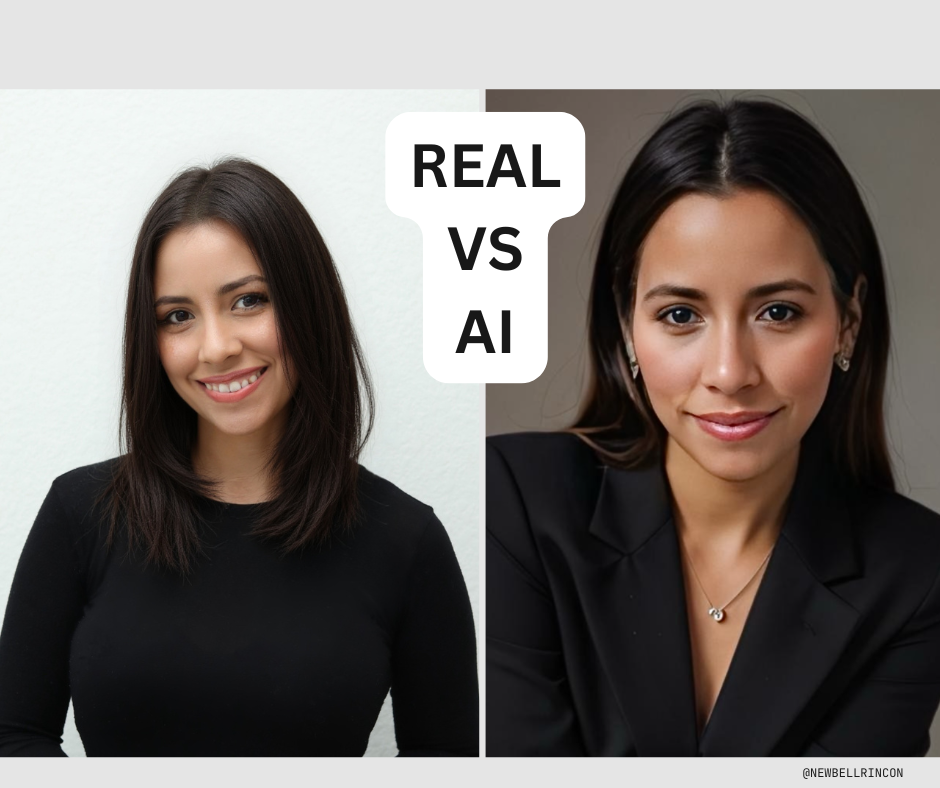
AI Headshots Are Getting Better.
Here's Why Real Photography
Still Wins.
The honest, data-backed answer to the question every Houston business owner is asking right now — and what it actually means for your brand, your leads, and your next session.
Let's start with the truth: AI headshots are not a scam. They are not going away. And the technology is genuinely getting better every year.
In 2023, AI portraits had obvious tells — wrong teeth, plastic skin, haunted eyes. In 2025, models like Flux and Midjourney's portrait tools were producing results that fooled the casual eye in blind tests. By 2026, the gap is closing fast.
So as a photographer based in Houston — and someone who works inside this industry every day — I want to give you the real answer to the question I get asked constantly: should I just use AI?
The data is more interesting than a simple yes or no.
The market reality:
both sides are growing
The first thing to understand is that this isn't a zero-sum competition. AI headshots and professional photography are both expanding simultaneously — but they're expanding into different markets.
The AI headshot market hit an estimated $420 million globally in 2025, up from $180 million in 2022 — and is projected to reach $640 million by 2028. Proshoot, 2026
At the same time, the professional headshot photography market was valued at $2.8 billion in 2025 and is projected to reach $5.1 billion by 2034, growing at 6.8% annually. Dataintelo, 2026
The market is bifurcating. AI is capturing the cost-conscious, convenience-driven segment. Professional photography is consolidating around something AI can't replicate: the premium, experience-driven, brand-intentional client. headshotphoto.io, 2025
For Houston and Katy businesses competing in industries like energy, real estate, healthcare, and legal — that premium segment is exactly where you live.
The paradox at the
center of the data
Here is the most important finding from recent research — and it's genuinely counterintuitive.
A 2024 Ringover study of 1,087 recruiters found that 76.5% preferred AI headshots in blind comparisons. The AI photos looked more polished, more symmetrical, more "professional" by conventional standards.
"Once told the image was AI-generated, two-thirds of those same recruiters said they'd be put off. The photo that looked better became a trust liability the moment someone discovered how it was made."
That's not a contradiction — it's the whole story. Undisclosed AI can look better. Disclosed AI erodes trust. And in B2B sales, trust is not a secondary consideration. It's the product. Ringover, 2024 — via Capturely, 2026
Getty Images' VisualGPS report — drawing from over 30,000 adults across 25 countries — found that 98% of consumers agree authentic images are pivotal for establishing trust, and 90% want to know if an image was created using AI. Getty Images, 2024
If your headshot looks better than you do on a Zoom call, you've created a trust gap before the meeting even starts. Authenticity isn't about perfection — it's about consistency between who someone expects and who they meet. Real photography, done well, closes that gap. AI photography, by definition, cannot.
What AI still gets wrong
in 2026
Even with genuine technical improvements, the current research identifies consistent failure points in AI headshots that matter specifically for B2B personal branding:
- Face likeness is the #1 complaint — cited by 63% of dissatisfied users
- Micro-expressions that feel "soulless" — an absence of asymmetry and imperfection
- You look different on Zoom than in your photo — immediate trust gap
- Racial and gender bias baked into training data
- Growing enterprise bans — many companies prohibit AI imagery in official materials
- Disclosure requirements increasing across platforms
- Exact likeness — the person in the photo is the person in the room
- Genuine micro-expressions and human specificity that build connection
- Consistent with how you look in video calls and in-person meetings
- Represents your actual appearance, background, and identity
- Compliant with all enterprise policies and platform requirements
- No disclosure required — because nothing is fabricated
The bias issue deserves its own mention. A 2024 study published in JAMA Network Open generated 1,000 AI physician headshots across five platforms and found that 82% depicted White physicians (vs. 63% of the actual U.S. physician workforce) and 93% depicted male physicians (vs. 62% actual). Three platforms produced zero images of Latino physicians. JAMA Network Open, 2024
For diverse businesses in a city as multicultural as Houston, this is not a theoretical concern. AI tools don't represent you — they represent a statistical average that was built on biased data.
Where AI is genuinely
winning — and that's okay
I believe in being honest about this industry, even when it's not flattering to photographers. Here's where AI headshots are legitimately strong:
| Use case | AI headshot | Real photography |
|---|---|---|
| Quick LinkedIn update, low stakes | Solid option — fast, affordable, good enough | Overkill unless you're already booking a session |
| Large teams needing visual consistency | Strong at scale — linear cost, uniform style | Possible with planning, but logistically heavier |
| Internal directory / intranet photos | Appropriate — low trust stakes | Preferred but not required |
| B2B sales, executive presence, lead gen | High risk — trust paradox applies directly | Clear advantage — authenticity is the differentiator |
| Brand photography, UGC, commercial content | Cannot replicate — requires real people, real environments | The only real option |
| Industries with high trust expectations (healthcare, finance, legal, real estate) |
Actively problematic — Getty data shows consumers expect authenticity here most | Essential — your credibility depends on it |
The honest version: if you need a quick LinkedIn photo and you're not actively selling or seeking clients, an AI headshot may genuinely serve you. But if your photo is part of a sales or trust-building strategy — which is exactly what a B2B professional's headshot is — the research is consistent.
What actually makes
a great professional photo
Knowing this, here's what I focus on at every session — the things that research and real-world results agree matter most:
AI will keep improving. Within a few years, it may close the visual quality gap almost entirely. But the trust paradox — the fact that knowing a photo is AI-generated changes how people feel about it — is not a technical problem. It's a human one. And it doesn't go away with better models.
The businesses that win in Houston's B2B landscape are the ones that understand what they're actually selling: themselves. Their judgment, their reliability, their presence. A photograph that is literally fabricated is a strange place to begin that relationship.
Real photography isn't a rejection of technology. It's a commitment to showing up as exactly who you are — which is, and will remain, the most powerful thing you can put on your website.
Ready to show up as exactly who you are?
Newbell Photography — brand, commercial & headshot sessions in Katy, Houston, and worldwide.